When Rhetoric Becomes Violence: From Decker to Kirk
12/16/20256 min read
In the first entry of this series, I argued that free speech requires boundaries — that celebrating assassination is not an opinion but an endorsement of terrorism. Here, I want to take that argument a step further.
Political violence doesn’t begin with bullets. It begins with words — words that reshape killing into something tragic, necessary, or even noble. That rhetorical sleight of hand creates moral permission. Once that permission takes root, celebration follows, and murder becomes a cause for applause instead of condemnation. The assassination of Charlie Kirk, and the online eruption that followed, proves the point.
The Language of “Sorrowful Violence”
In April of 2025, Nicholas Decker published an essay titled “When Must We Kill Them?” which framed political violence as something sorrowful but unavoidable. He described killing not as an act of hatred but as a grim duty, heavy on the conscience, but ultimately necessary for survival. This kind of rhetoric matters. By clothing violence in tragedy, it strips away the instinctive moral shock.
It works like rhetorical anesthesia: numbing our natural revulsion to killing so that people can imagine it as tragic but justified. That act of imagination is the first step toward normalization. Once killing is reframed as reluctant necessity, it becomes easier to treat it as a legitimate, even noble, response to politics.
But what looks restrained on the page rarely stays that way in culture. Decker wrote as though violence would weigh heavily on the conscience. In practice, Charlie Kirk’s assassination wasn’t met with sorrow. It was met with laughter and applause.
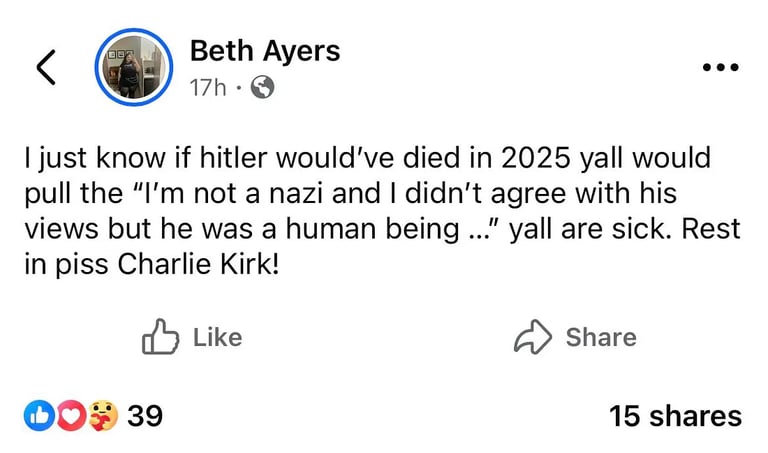
Exhibit A: A Facebook user comparing Kirk’s death to Hitler’s, celebrating it as justice rather than tragedy.
If Decker’s essay tried to sanctify violence with sorrow, this post sanctifies it with mockery. The language of “tragic necessity” has collapsed into the language of celebration. And once celebration enters the picture, the distance between rhetoric and reality disappears entirely.
From Justification to Celebration
Once violence is framed as necessary, the shift to celebration is inevitable. What begins as “we must” soon becomes “I’m glad someone did.” The assassination of Charlie Kirk exposed this progression in real time.
Across social media, his death wasn’t treated as a tragedy or even as a grim political necessity but was treated as a joke, a meme, and a moment for applause.


Exhibit B: “Finally someone has good aim” — murder reframed as comedy, the bullet itself becoming the punchline.
Others moved quickly beyond Kirk himself, using his assassination as a springboard to justify further violence.
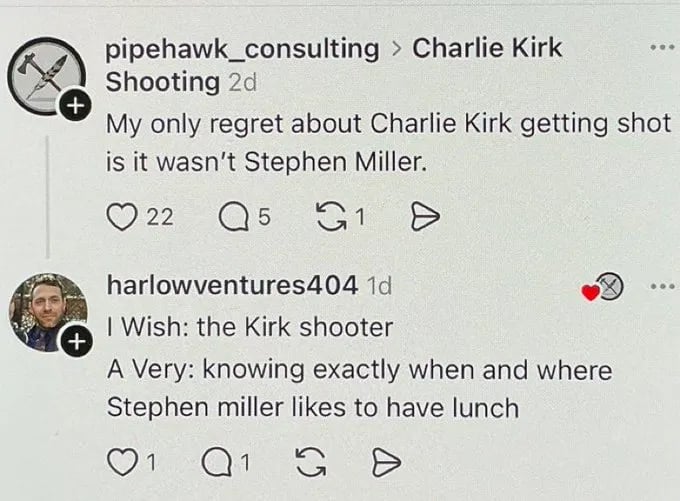
Exhibit C: “My only regret… it wasn’t Stephen Miller.”
And it didn’t remain confined to individual users. Public displays appeared in the streets, turning assassination into spectacle.
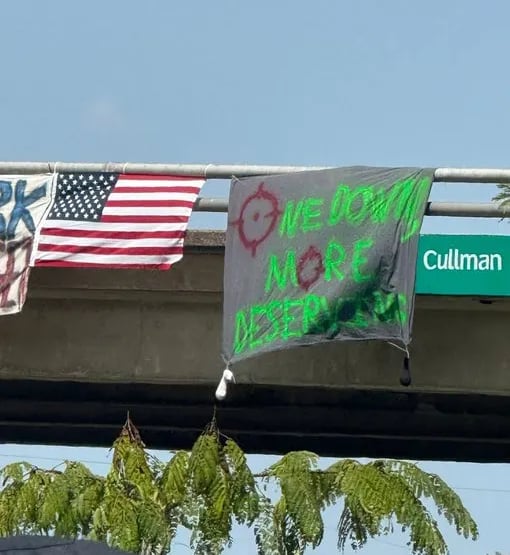
Exhibit D: Banner reading “One down, more deserving” — isolated posts transformed into collective declaration.
Here the rhetorical slide is complete. What Decker framed as sorrowful necessity has become gleeful affirmation. Murder is not merely justified — it is openly celebrated, and the call for more is shouted without shame.
The Danger of Romanticizing Violence
Celebration is only one stage. The next is romanticization — the attempt to cloak violence in the language of history, destiny, and justice. Once people stop treating assassination as a crime and start treating it as progress, political murder is no longer just tolerated. It is valorized.
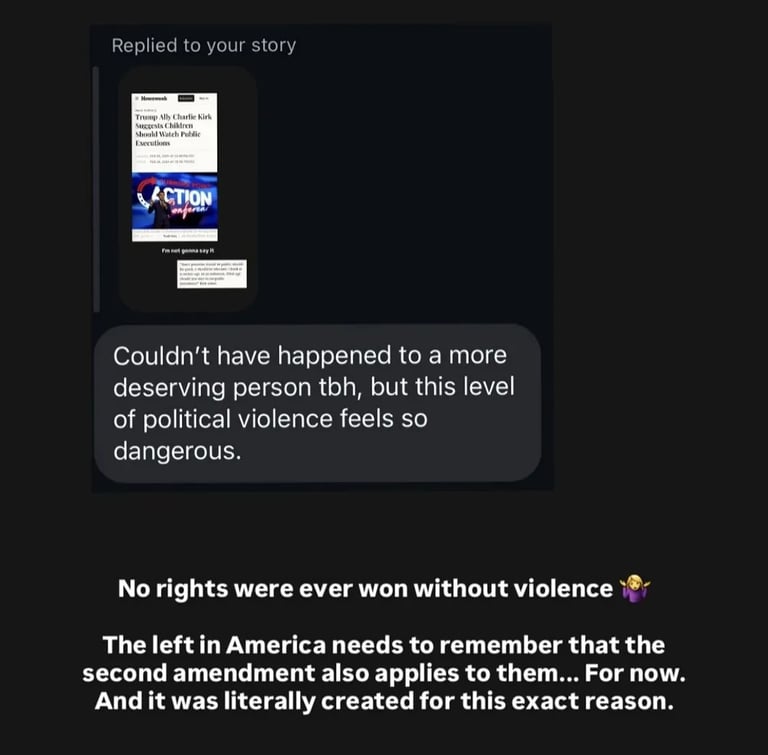
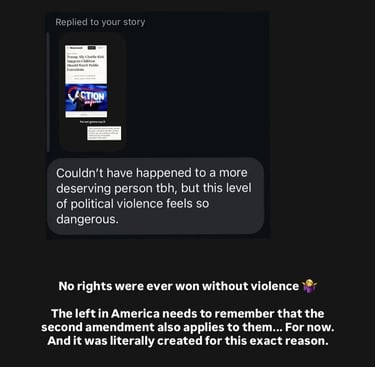
Exhibit E: “No rights were ever won without violence” — assassination reframed as part of a heroic tradition from Vtuber @kaminariclara.
This rhetoric doesn’t present violence as a breakdown of politics. It presents violence as the engine of politics itself. The suggestion is clear: killing a political opponent isn’t just acceptable, it’s necessary.
History has seen this move before. In the 1960s and 70s, radical groups like the Weather Underground began by arguing that violence was a tragic but necessary response to injustice. Within a few years, that language hardened into bombings, kidnappings, and assassinations. The line between “necessary” and “glorious” blurred, and the culture of resistance became a culture of bloodshed.
We see the same slide happening now. What began as a shooting treated with glee has been recast as proof that “the struggle continues.”
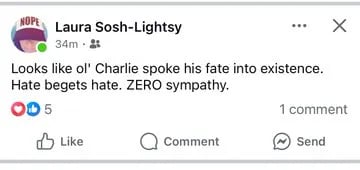
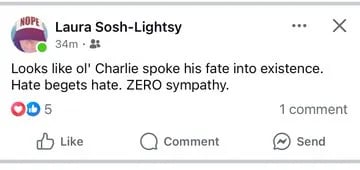
Exhibit F: From Facebook user Laura Sosh-Lightsy,“He spoke his fate into existence. Hate begets hate.”
This is not just an excuse — it is a rebranding of assassination as destiny. And once violence is romanticized, it ceases to be shocking at all. It becomes, in the minds of those cheering, inevitable.
Why Drawing the Line Matters
When violence is celebrated and then romanticized, it doesn’t stay confined to fringe corners of the internet. It bleeds into culture, institutions, and politics. And once it does, society has no choice but to decide where the boundary lies.
Humor became one of the most common ways to mask the celebration of Kirk’s murder. Posts circulated that turned his death into punchlines — mockery delivered with a laugh-cry emoji.
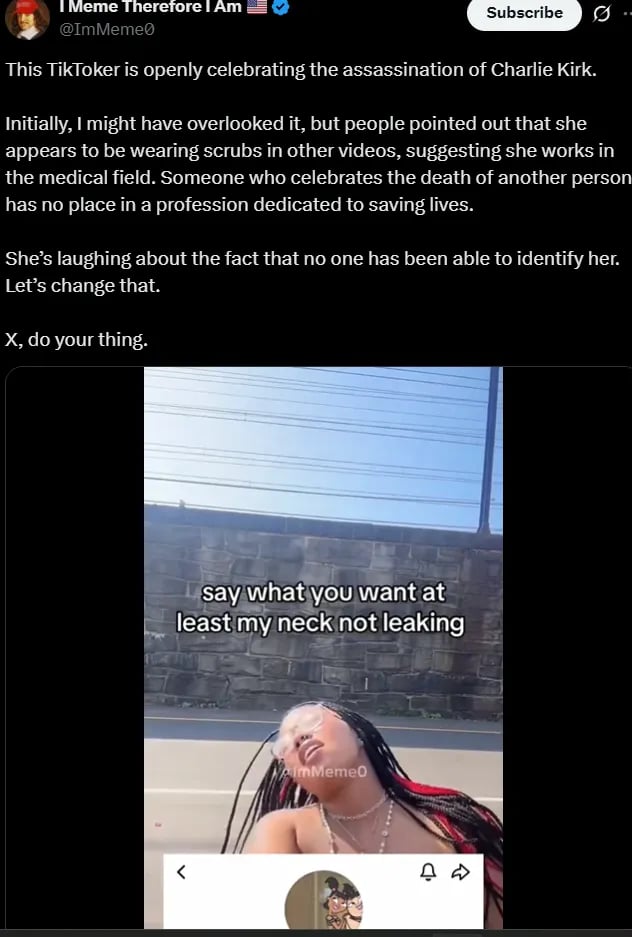
Exhibit G: “At least my neck not leaking” — assassination reduced to entertainment on TikTok.
Others leaned into irony and meme culture as a way of signaling approval without saying it directly.
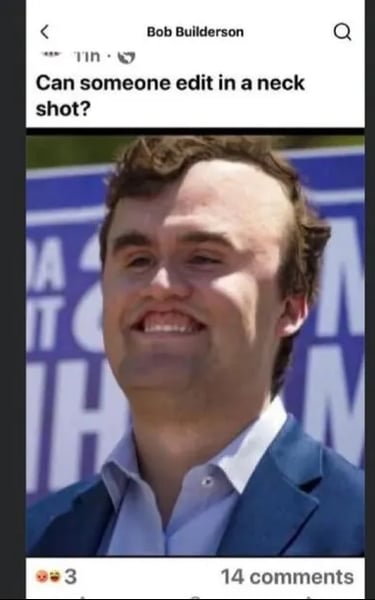
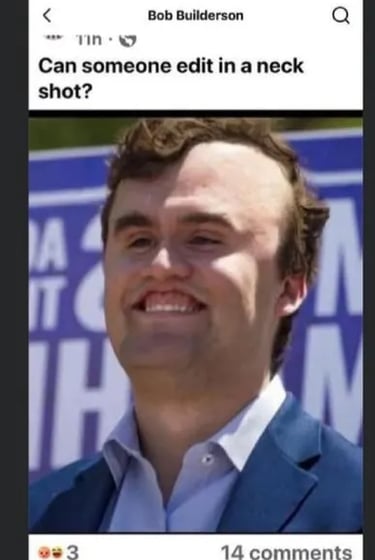
Exhibit H: “Can someone edit in a neck shot?” — a murder request masked as a meme.
This is how violence is normalized. Once assassination becomes a meme, it stops being an atrocity and starts being cultural wallpaper — something seen, shared, and laughed at without pause.
Worse still, this rhetoric has not been limited to anonymous accounts. An Army Major posted that Kirk was “not a martyr, but a victim of his own rhetoric,” only deleting it under pressure. Susquehanna University faced backlash after a student group disrupted a vigil for Kirk, with administrators accused of tolerating open celebration of his murder.
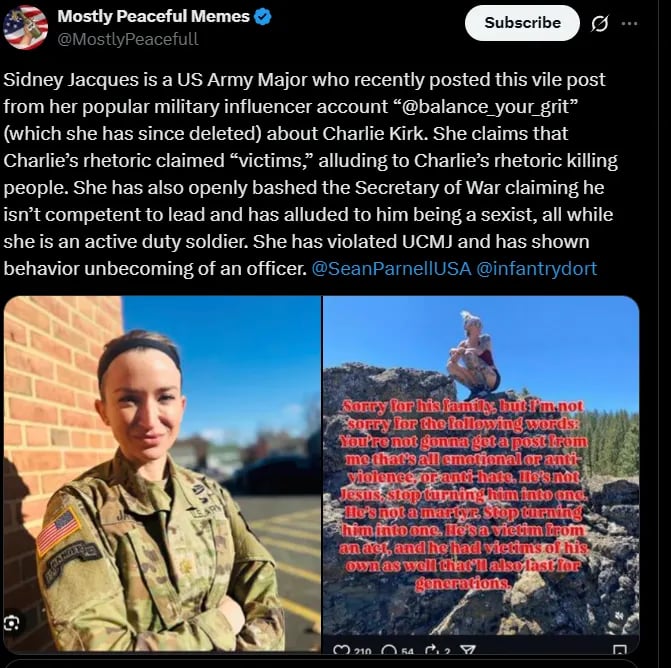
Exhibit I: Army officer dismissing Kirk as “a victim of his own rhetoric.”
And the political fallout reached into Congress. Rep. Nancy Mace reported receiving voicemails celebrating Kirk’s assassination. Rep. Ilhan Omar faced scrutiny after remarks perceived as minimizing the act. These weren’t isolated users with throwaway accounts. They were elected leaders, institutions, and representatives.
At this point, society cannot shrug and say “it’s just speech.” If we treat open celebration of assassination as acceptable discourse, we send a signal that political violence is legitimate and that future killers will not be condemned, but applauded.
This is why accountability matters. Employers, platforms, communities, and political institutions must draw the line clearly: criticism and dissent are speech, but cheering for murder is not. To blur that line is to invite escalation. To enforce it is to preserve the very conditions where speech, not bullets, settles political disputes.
From Words to Bullets
Nicholas Decker once framed violence as a sorrowful necessity — a heavy duty that history might one day demand. That kind of rhetoric can feel abstract, even academic. But what we witnessed after Charlie Kirk’s assassination proves it is anything but. The language of “tragic necessity” has already mutated into the culture of celebration. What was once theory on the page became laughter, memes, and public banners cheering murder in the streets.
This is why rhetoric matters. It does not stay contained. It primes people to see killing as inevitable, then as justified, and finally as worthy of applause. Once assassination is romanticized as progress, the next shot is easier to fire, and the next crowd easier to cheer.
The celebration of Kirk’s murder was not just a reaction to one man. It was a symptom of a culture that has lost its ability to draw boundaries. A culture that confuses freedom with license and thinks that free speech means the right to glorify bloodshed without consequence.
But society does have the power to draw the line. We must insist that criticism, dissent, and even outrage remain protected — but that open celebration of political assassination is not “free speech.” It is an endorsement of terrorism. And the only way to stop this rhetoric from becoming reality again is to hold it accountable wherever it appears.
From Decker to Kirk, we see the same trajectory: sorrow becomes justification, justification becomes celebration, and celebration becomes normalization. If that cycle is not broken, we will not just be writing about rhetoric anymore. We will be counting bodies.