The Vulnerability of Western Societies to Islamist Threats: Denial, Immigration, and Political Exploitation
12/21/20253 min read
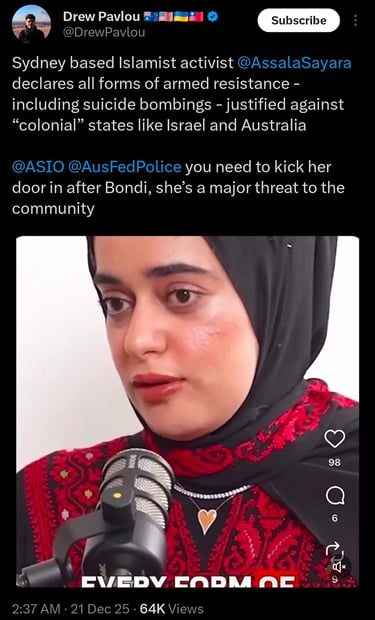
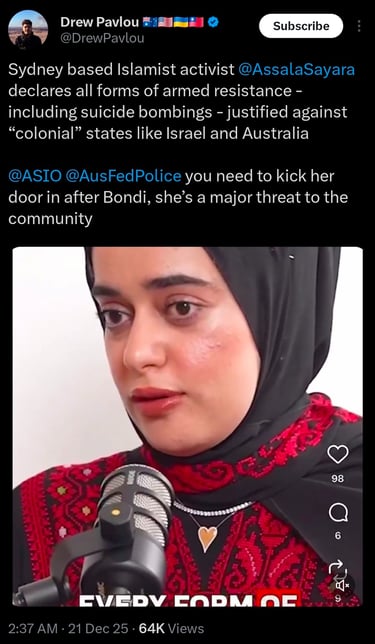
Recent events, such as the ISIS-inspired terrorist attack at Bondi Beach in Sydney on December 14, 2025—where two gunmen targeted a Jewish Hanukkah celebration, killing 15 people—highlight a growing concern: segments of Islamic society, influenced by extremist ideologies, pose a direct threat to Western values and security. ISIS praised this massacre as a "source of pride" in its propaganda, even without claiming direct responsibility, underscoring the inspirational role of such violence. Yet, responses from some political figures and liberals often downplay or deny the religious motivation. For instance, British MP Adnan Hussain stated that the attack should not be used to "vilify a faith or its followers," emphasizing a heroic act by a Muslim bystander while avoiding the Islamist ideology driving the perpetrators.
This pattern of denial extends to broader societal vulnerabilities. In the event of a large-scale attack similar to October 7 in Israel, many Western cities—hampered by local leadership weakened by nepotism and diversity, equity, and inclusion (DEI) initiatives—would likely be overwhelmed, relying on delayed federal or military intervention. Experiences in places like Rhode Island and institutions such as Brown University illustrate how prioritizing ideological hiring over competence can erode preparedness.
The Exploitation of Liberal Empathy
Islamic extremist groups have effectively exploited Western liberal empathy and openness. A significant portion of liberals refuse to acknowledge that elements within Islamic society actively seek to undermine or destroy the West. This refusal stems from several interconnected reasons:
Naive Optimism and Self-Perception: Many liberals believe that by opposing "Islamophobia" and supporting open borders, they will be seen as the "good" Westerners and spared in any conflict. They envision a utopian global society where borders dissolve, and everyone becomes equal citizens of the world.
Reluctance to Admit Error: Acknowledging the threat would require admitting past policies were wrong—particularly the idea that cultural differences are merely superficial, driven by location or resources rather than deeper ideological or religious divides.
Electoral and Financial Incentives: Immigration policies have created voting blocs dependent on welfare systems, which immigrants can sometimes exploit. In return, they provide reliable votes for left-leaning parties, such as Democrats in the U.S. Regulating these communities risks alienating this base and costing political power.
Misinterpretation Through Irony: Steeped in postmodern irony and symbolism, some on the left view radical Islamic calls for conquest—such as "Islam in every house"—as metaphorical rather than literal intentions.
As one observer noted: "If they conceded that Islam was incompatible with their values, then they’re conceding that leftism isn’t 1) universal, 2) true, or 3) inevitable as the end of history."
Mass Immigration as an Economic and Political Strategy
Mass immigration into the West was often justified as a solution to demographic decline and economic stagnation: falling birth rates, rising costs, and shrinking workforces. Policymakers imported large numbers of migrants, providing taxpayer-funded support in hopes of boosting consumption and sustaining growth. This also helped maintain political power through new voters.
However, this approach backfired in unanticipated ways. Many migrants remit substantial funds back to their home countries, sometimes supporting extremist causes, rather than fully integrating into the host economy. As one analysis put it: "They didn't anticipate the illegals sending the vast bulk of their funds back to the shitholes they came from, to fund terrorists."
Political Mobilization Through Religious Communities
Commentator Katie Hopkins has described how this dynamic plays out in Democratic strongholds in the U.S., such as Minnesota, Minneapolis, and Dearborn, Michigan. Large Muslim populations are concentrated in specific areas, mosques are built with external funding, and community leaders—often imams—wield significant influence. Voting aligns with religious directives rather than individual policy preferences, creating bloc power.
Hopkins warns: "These guys need that voting block. They need the Muslim votes... People are going to vote according to what the Imam tells them to do. They are voting according to religion instead of any policy or political belief."
She contrasts mosques with churches: "Do not mistake mosques for churches. They are not places of worship. They are places of organization and mobilization."
A parallel exists in Europe with Belgium's ISLAM Party, which has advocated for policies like mandatory halal food in schools, headscarf allowances, and even gender segregation on public transport—steps toward broader societal Islamization.
The Cost of Denial
The Bondi Beach attack, praised by ISIS yet met with calls not to link it to Islam, exemplifies the broader issue. Combined with weakened local leadership—from DEI-focused institutions to politicized immigration—Western societies risk helplessness in the face of coordinated threats. Until liberals and policymakers confront the ideological motivations behind such violence, rather than excusing or downplaying them, vulnerabilities will persist. True security requires honest assessment, not empathy exploited as weakness.