The Last Public Christmas? Europe's Festive Season Under Siege in 2025
THE FALL
12/25/20253 min read
As families across Europe prepare for Christmas 2025 with the traditional joy of public celebrations, Christmas markets glowing with lights, nativity scenes in town squares, carols echoing in the cold air, is overshadowed by fear, heavy security, vandalism, and outright cancellations. What was once a cherished cultural and religious tradition now feels increasingly under threat, with many asking if this could be the last openly celebrated Christmas in much of Western Europe.
The rise of mass migration, particularly from Muslim-majority countries, combined with a surge in Islamist-inspired terrorism and targeted disruptions, has transformed holiday seasons into high-risk events requiring concrete barriers, armed police, and restricted access. While officials insist the measures protect public safety, critics argue they signal a deeper cultural surrender: the gradual erasure of Christian traditions to accommodate growing migrant populations and avoid offense.
Terror Threats Turn Markets into Fortresses
Christmas markets, long symbols of community and heritage, have become prime targets for Islamist terror plots:
In December 2025, German police arrested five men (including an Egyptian imam and three Moroccans) suspected of planning a vehicle-ramming attack on a Bavarian Christmas market, inspired by jihadist ideology. Authorities described the imam urging followers to "kill or injure as many people as possible" during the festive season.
This followed the deadly 2024 Magdeburg attack, where a Saudi national drove an SUV into crowds, killing six and injuring over 300—prompting a nationwide security overhaul.
Security costs have skyrocketed: Germany reports a 44% increase in spending over three years, with concrete barriers, checkpoints, and surveillance now standard. Smaller markets in Austria (e.g., Styria) have canceled entirely due to unaffordable measures.
Paris canceled its traditional New Year’s Eve concert on the Champs-Élysées over "unprecedented pressure on security resources" and "very high" terror threats, citing risks from al-Qaeda and ISIS.
Markets now resemble militarized zones rather than festive gatherings, with many families opting out due to the heavy police presence and fear.
Vandalism and Desecration of Christian Symbols
Beyond terror, nativity scenes and Christmas displays face escalating vandalism:
In Erbach, Germany, a live nativity was attacked on November 30, 2025: two donkeys beaten, decorations destroyed, and vandals defecated inside a nearby church.
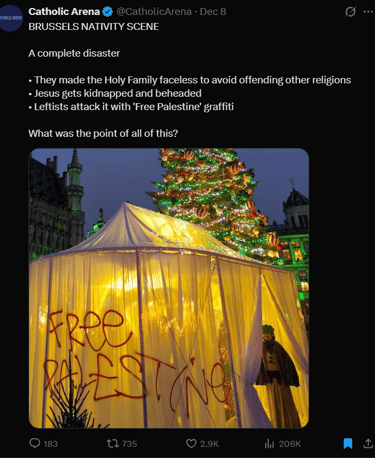
Brussels' controversial faceless nativity (designed for "inclusivity") saw its infant Jesus figure beheaded and head stolen overnight in late November.
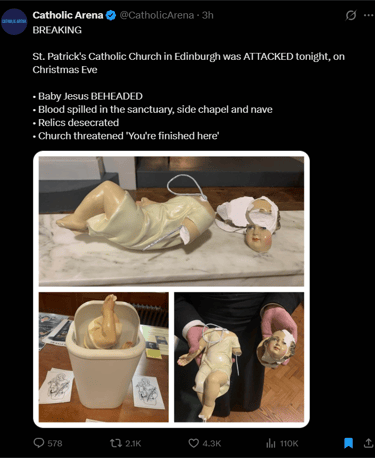
Similar incidents in Amiens (France), Trieste (Italy), and other cities involved decapitated baby Jesus statues, broken plexiglass, and destroyed figures.
Reports describe anti-Christian motives, with some attacks linked to pro-Palestine or Islamist rhetoric.
These acts are often downplayed or framed as "protests" rather than hate crimes, while perpetrators are rarely identified publicly.
Disruptions and "Inclusive" Alternatives
Some events have been actively disrupted:
In Brussels, pro-Palestine activists set off smoke flares and surged through a Christmas market opening, blending politics with holiday interference.
In Milan, groups climbed statues near festive areas with flags and loud music, though some footage was older.
Meanwhile, certain "inclusive" celebrations have emerged:
In the UK, a few outdoor Christmas events have been promoted as attended heavily by Muslims, with organizers emphasizing secular or multicultural framing (e.g., avoiding overt Christian elements like nativity plays or carols).
These are presented as bridges between communities, but critics see them as further dilution of Christian heritage.
The Demographic Shift of Mass Migration
Europe's Muslim population has grown rapidly through migration and higher birth rates—estimated at 6% continent-wide in 2025, with projections of 10–20% in some Western countries by mid-century under continued high migration. In cities like Brussels, Malmö, or parts of Paris and London, Muslim majorities in certain neighborhoods have already changed the cultural landscape.
Many observers now describe 2025 as the tipping point:
Public Christian expressions (markets, nativities, carols) face such heavy restrictions, costs, and risks that they may become unsustainable.
Politicians often avoid naming the Islamist motivation behind threats or vandalism, focusing instead on "hate speech" crackdowns or gun control.
Some predict a future where Christmas survives only in private homes or heavily securitized enclaves—while public spaces become "neutral" or multicultural "winter festivals."
Is this truly the last openly celebrated Christmas in Western Europe? The trend suggests a gradual conquest—not by force alone, but by demographic weight, cultural accommodation, and fear of violence. Traditional celebrations persist in Eastern Europe (e.g., Poland, Hungary), where migration levels remain low and Christian identity is defended more robustly.
As one European commentator put it: "They didn't conquer with armies. They conquered with numbers—and we surrendered our traditions to avoid offending them."
Stay updated on Christmas under threat Europe 2025, Islamist attacks Christmas markets, nativity scene vandalism 2025, Europe Muslim migration cultural change, and leftist violence holiday suppression for ongoing developments.
This Christmas, lights still shine—but the shadows grow longer. For many, the joy feels borrowed, fragile, and possibly fleeting.
Sources: Euronews, Fox News, Reuters, Hungarian Conservative, Daily Caller, Brussels Signal, and multiple December 2025 reports.